
Quick answer: HIPAA is the 1996 US law that governs how your health information is protected. It sets five main rules, gives you real rights over your records, and penalises anyone who mishandles them. Faxing became healthcare’s default secure channel because a compliant fax service — one that signs a Business Associate Agreement and encrypts your data in transit and at rest — meets HIPAA’s Security Rule. That’s why online fax now does the same job without a machine. Below is the plain-English version of every major rule, the penalties, and how to check a service is genuinely compliant.
HIPAA decides what can and can’t happen to your medical records, and yet most of us never sit down to learn what it actually says. Unless you’re a lawyer, federal regulations are intimidating, and it’s easy to assume your doctor’s office is just handling it. They mostly are — but understanding the law yourself is what lets you spot the gaps.
This guide is the long version. We’ll cover what HIPAA is and how it shapes your daily healthcare, walk through every major rule in plain English, look at the penalties that get handed down when things go wrong, and explain why fax — of all things — became healthcare’s default secure channel. We’ll also cover how to verify whether a given fax service is actually HIPAA compliant, and what the equivalent rules look like if you’re outside the US. If you’re already past the explainer and just want to see specific services compared, our HIPAA compliant fax service rankings are the resource for that.
What is HIPAA and How Does It Impact Me?
The Health Insurance Portability and Accountability Act, often shortened to HIPAA, was signed into law in 1996 and set the universal standards for how patient health information is handled. The original 1996 act was about portability — making sure you didn’t lose your health coverage when you switched or lost a job — but the privacy and security rules most people associate with HIPAA today were added later through subsequent rule-making. Together, these protections bolstered the healthcare industry against fraud, theft, and cyber-attacks, and gave patients real rights over their own data.
Some specific ways HIPAA affects you personally:
- It prevents healthcare providers and other businesses (known as covered entities) from disclosing your protected health information to anybody you don’t want them to.
- It protects health insurance coverage when you lose or leave a job, eliminating the “Job Lock” problem of staying in a position purely to keep your healthcare.
- It makes group coverage more accessible for those with preexisting conditions.
- It gives you the right to access your own medical records — and to receive an electronic copy at no cost.
- It gives you the right to request corrections when something in your record is wrong.
- It lets you ask for confidential communications — for example, requiring your provider to call only your mobile or send mail to a specific address.
- It requires your provider to notify you if your data is breached.
- It gives you the right to file a complaint with the HHS Office for Civil Rights when a covered entity mishandles your information.
Above all, HIPAA sets the universal standard for privacy and security of health information through its Administrative Simplification provisions, which lay out five major rules:
- The Privacy Rule
- The Transactions and Code Sets Rule
- The Security Rule
- The Unique Identifiers Rule
- The Enforcement Rule
The Transactions and Code Sets Rule and the Unique Identifiers Rule mostly govern how healthcare providers exchange data with insurers and clearinghouses — important machinery, but not something most patients ever interact with. The Privacy Rule, Security Rule, and Enforcement Rule are the consumer-facing ones, and they’re the ones we’ll cover in detail below. We’ll also cover the Breach Notification Rule, which was added by the HITECH Act in 2009 and is what dictates how you find out when something goes wrong.
Privacy Rule
The Privacy Rule sets out exactly how a healthcare provider can and can’t use your sensitive information, how they have to store it, and what rights you have over it. In short, it protects your privacy while still allowing the flow of information needed for high-quality healthcare.
The rule applies to “covered entities” — healthcare providers, health plans, and healthcare clearinghouses — as well as their “business associates,” which are any third-party vendors who handle protected health information on a covered entity’s behalf. A HIPAA compliant fax service is a business associate, which is why a signed Business Associate Agreement (BAA) is non-negotiable when one handles your data.
Protected Health Information (PHI) is defined broadly. Anything that ties health information to your identity — name, address, dates, medical record numbers, even photographs or biometric identifiers — counts as PHI. Strip those identifiers and the data becomes “de-identified” and falls outside HIPAA’s scope; keep them and the rule applies regardless of format, whether the data lives in an EMR, a fax queue, or a paper file in a cabinet.
Covered entities can use and disclose your PHI without explicit authorization for what’s called TPO — Treatment, Payment, and Operations. That covers your doctor sharing records with a specialist, billing your insurance, or running internal quality reviews. For most other uses (marketing, research, sale of data), they need your written authorization. The rule also requires “minimum necessary” disclosures: only the information actually needed for the task, not your entire chart.
On the patient side, the Privacy Rule guarantees you the right to access your own records (electronically and at no cost), the right to request amendments when something is wrong, the right to an accounting of disclosures, the right to request restrictions on certain uses, and the right to confidential communications. Every covered entity must give you a Notice of Privacy Practices that spells out how they handle your data and how to file complaints.
Security Rule
Where the Privacy Rule covers all PHI, the Security Rule applies specifically to electronic PHI (ePHI) — anything stored or transmitted in digital form. It requires covered entities and their business associates to put three categories of safeguards in place:
Administrative safeguards
Workforce training, formal risk analysis, contingency planning, access management policies, designated security officials, and sanctions for violations.
Physical safeguards
Controlling who can physically access servers and devices, workstation security policies, and secure disposal and reuse of media.
Technical safeguards
Unique user IDs and access controls, audit logs that record who accessed what, integrity controls that detect tampering, and transmission security through encryption.
Each safeguard is classified as either “required” or “addressable.” Required means exactly what it sounds like; addressable means the entity can either implement it or document why an alternative measure provides equivalent protection. Encryption, notably, is “addressable” rather than required — but in practice, encrypting ePHI in transit and at rest is the only sensible way to comply, and it also creates a “safe harbor” under the Breach Notification Rule (more on that in a moment).
For an online fax service, the Security Rule is what dictates the technical baseline: encrypted transmission, audit trails of every send and receive, role-based access controls, and a formal process for handling and reporting security incidents. A service that can’t show those things isn’t HIPAA compliant, no matter what the marketing copy says.
Breach Notification Rule
Added by the HITECH Act in 2009, the Breach Notification Rule is what kicks in after something goes wrong. When unsecured PHI is acquired, accessed, used, or disclosed without authorization, covered entities must notify the affected individuals — by mail, or by email if the patient has agreed to electronic notice — without unreasonable delay, and no later than 60 days after the breach is discovered.
The rule scales by size. Breaches affecting fewer than 500 people are reported to HHS in an annual log. Breaches affecting 500 or more trigger immediate notification to HHS and to prominent local media in the affected state, and they end up listed publicly on what’s informally known as the “Wall of Shame” — the OCR breach portal at hhs.gov, where anyone can browse current and historical incidents.
One detail worth knowing: properly encrypted PHI is exempt from these notification requirements. If a laptop is stolen but its drive is encrypted to current standards, no breach notification is required because the data is considered unreadable. This is the “safe harbor” provision, and it’s a major reason healthcare organizations push encryption hard — it converts a reportable, reputation-damaging incident into a non-event.
Enforcement Rule
The Enforcement Rule sets out who polices HIPAA and how. The HHS Office for Civil Rights (OCR) is the federal body that investigates complaints, conducts compliance reviews, and assesses penalties. Most enforcement starts with a complaint — from a patient, an employee, or another covered entity — though OCR also runs proactive audits and investigates large breaches reported under the Breach Notification Rule.
Penalties are tiered by culpability, ranging from situations where the entity didn’t know and couldn’t reasonably have known about a violation, up to willful neglect that the entity didn’t even attempt to correct. Each tier carries a per-violation fine and an annual cap, and the most serious cases can run into seven figures. Criminal penalties (including prison time) are available for the most egregious violations, particularly knowing misuse of PHI for personal gain. We’ll look at what those numbers actually look like in practice below.
What Happens When HIPAA Is Violated
The penalties under the Enforcement Rule sound abstract until you look at actual settlements. OCR publishes its Resolution Agreements and Civil Money Penalties publicly, and the figures involved are not small. Anthem Inc. paid $16 million in 2018 to resolve a series of cyberattacks that exposed the records of nearly 79 million people — at the time, the largest HIPAA settlement on record. Memorial Healthcare Systems paid $5.5 million in 2017 after employees inappropriately accessed patient records. Smaller settlements in the hundreds of thousands of dollars are common, and they show up across the spectrum — large hospital systems, small practices, dental offices, imaging centers.
For faxing specifically, the recurring breach pattern on the OCR portal is misdirected faxes — a wrong number entered into a cover sheet, a saved contact that was never updated, a fax queue routed to the wrong department. A single fax sent to the wrong recipient is a reportable disclosure, and if it affects enough people (a batch covering many patients, for instance), it lands publicly on the breach portal. This is part of why traditional fax workflows lean heavily on pre-programmed numbers and confirmation receipts, and why properly built online fax services include audit trails and delivery verification.
If you believe a covered entity has mishandled your information, the primary remedy is to file a complaint with the OCR. You can do this online through the HHS complaint portal within 180 days of when you knew or should have known about the violation. OCR investigates and, if it substantiates the complaint, can require corrective action, impose fines, or refer the matter to the Department of Justice for criminal prosecution.
One thing worth knowing: HIPAA itself does not give patients the right to sue providers directly for violations. There is no private right of action under the federal statute. Many state laws — California’s Confidentiality of Medical Information Act, for example — do provide stronger protections and direct legal remedies, and common-law claims like negligence or invasion of privacy are sometimes available depending on the circumstances. But the federal complaint process through OCR is the universal first step.
HIPAA Compliance and Fax Machine
Once the Privacy, Security, and Enforcement Rules were published, traditional fax machines emerged as the most secure HIPAA compliant communication method between healthcare professionals. This happened for a few reasons. Since a traditional fax machine uses a phone line to send and receive faxes, it is seen as having enhanced security — point-to-point transmission between fax numbers and delivery receipts give organizations a clean audit trail and meaningful data protection. Healthcare providers invested heavily in secure fax infrastructure for medical records, and faxing locked in as the default.
In a massive, complex industry like healthcare, companies have invested heavily in their EMR systems, and changing technology away from faxing would require an enormous amount of money, training, and time to implement. The “if it isn’t broken, don’t fix it” philosophy takes precedence, and so faxing is still a mainstay. Even when change is on the horizon, it takes a long time. It took well over a decade for many parts of HIPAA to come into effect after being signed in 1996; faxing isn’t going away on a faster timeline. Being able to use a fax service is therefore essential, but with the emergence of online faxes, you don’t need a traditional machine to be HIPAA fax compliant.
There are other reasons the healthcare industry at large still heavily relies on faxing and fax machines to ensure HIPAA compliance, despite the availability of more modern technology.
Why Faxing Beats Email and Text Under HIPAA
The technical case for fax over email or text starts with attack surface. A traditional fax machine connects to fewer networks and secondary devices than an email server, and many fax setups have no internet connection at all — breaching one would mean physical access to the phone line itself, often inside a secure facility. Pre-programmed contact lists on fax machines also reduce the risk of misdirection compared to a typed-out email address on a busy day.
Phishing matters too. It’s trivial for an attacker to get someone to click a link or open an attachment in an email; over fax, that vector mostly doesn’t exist. There’s no payload to deliver to a fax machine that turns into a foothold on a hospital network. Healthcare organizations targeted by ransomware almost always get hit through email, not fax.
The regulatory case is even more direct. Standard email and SMS lack widespread support for the encryption and access controls the Security Rule requires. Texting has been described by industry professionals as a “HIPAA disaster zone,” and unsecured email is similarly out of compliance unless the provider can satisfy every Security Rule safeguard, including a signed BAA with the email host.
This is where consent comes in. To use email or text with patients, a covered entity has to first obtain written consent — and that consent shifts the risk onto you. Once you’ve signed off on receiving PHI by an inherently less-protected channel, you’ve accepted that the information may be intercepted or misdelivered. Faxing keeps that risk on the covered entity’s side because compliant fax workflows already meet the Security Rule baseline. If something goes wrong when you send or receive faxes through a compliant service, the entity is on the hook, with substantial per-violation fines under the Enforcement Rule that can reach six figures or higher in serious cases.
None of this changes the fact that patients want modern channels. By 2015, 37% of people had used personal email to contact their doctor and 18% had even used Facebook — neither of which is HIPAA compliant. The pressure to combine the security of fax with the convenience of mobile devices is what produced the modern category of online fax services.
How Online Fax Services Bring HIPAA Faxing to Modern Devices
The case for traditional fax machines as a HIPAA-compliant channel is solid, but the case against them is also obvious to anyone who has ever owned one. They’re expensive to buy and maintain, they need a dedicated phone line, they take up physical space, and they tie you to a specific location to send or receive a document. Online fax services solve those problems by routing fax traffic through internet-connected apps and web interfaces while still terminating in the regular fax network on the recipient end. From the recipient’s fax machine, an online fax looks exactly like any other fax.
The catch is that not every online fax service is HIPAA compliant. The provider has to sign a Business Associate Agreement, encrypt PHI in transit and at rest, log every send and receive for audit purposes, and handle access control and breach response properly. Services that cater to healthcare workflows do this; services aimed at general consumers often don’t. Among the major options, Municorn Fax is designed around healthcare-grade requirements, with delivery receipts and a HIPAA-compliant infrastructure that puts a working fax machine in your pocket. Other providers take similar approaches, and our HIPAA compliant fax service rankings compare the major ones on price, features, and how their compliance setup actually holds up.
What Full HIPAA Compliance Looks Like in Practice
“HIPAA compliant” is a phrase that gets used loosely in marketing copy. In practice, it means the provider has done a specific set of things: completed a formal risk analysis, implemented all required Security Rule safeguards, signed BAAs with covered entities and any subcontractors that touch PHI, set up audit logging and access controls, written incident response procedures, trained staff, and ideally had the whole package independently assessed against a recognized framework like HITRUST CSF or a SOC 2 Type II audit referencing HIPAA criteria.
Most providers won’t show you any of that. The ones that take compliance seriously will publish certificates or attestation letters from independent assessors. Here’s what one looks like in practice — Municorn Fax’s HIPAA compliance certificate, issued by the independent assessor Compliancy Group:
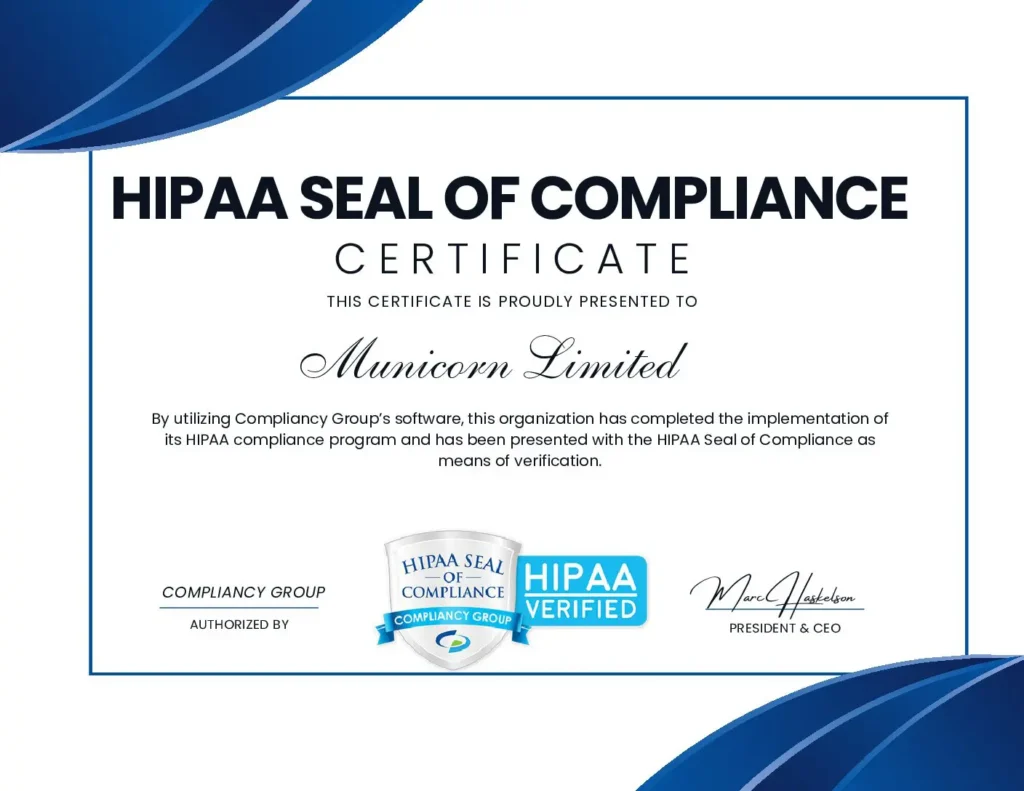
A document like this is what to ask for when a fax service claims compliance — not a vague “we’re HIPAA compliant” line on a marketing page. For a side-by-side look at which providers actually produce this kind of evidence and how they compare on the rest of the workflow, see our HIPAA compliant fax service rankings.
How to Verify a Fax Service Is Truly HIPAA Compliant
If you’re evaluating a fax service yourself rather than relying on a ranking, here’s the checklist that separates real compliance from marketing claims. Any service that can’t answer all of these in writing isn’t compliant.
- Will they sign a Business Associate Agreement? A BAA is the legal contract that makes the provider accountable under HIPAA. No BAA, no compliance — full stop. Free consumer fax apps almost never offer one.
- How is PHI encrypted, in transit and at rest? The accepted standard is TLS 1.2 or higher for transmission and AES-256 for stored data. “We use encryption” without specifics is a red flag.
- Are audit logs available, and how long are they retained? The Security Rule requires a record of who accessed what and when. The provider should be able to produce these logs on request, and HIPAA requires retention of related documentation for at least six years.
- What access controls are in place? Unique user IDs, role-based permissions, automatic logoff, and multi-factor authentication for administrative access are the baseline. Shared logins are an immediate disqualifier.
- What’s the breach notification process? The provider must have a documented procedure for detecting, investigating, and reporting breaches to you within HIPAA’s required timelines.
- How are subcontractors handled? Any third party the provider uses to handle PHI — cloud hosting, SMS gateways, support tools — must also have a BAA in place. Ask if they can name their major subprocessors.
- Is there independent assessment evidence? HITRUST CSF certification, SOC 2 Type II reports referencing HIPAA, or third-party HIPAA attestation letters are the strongest signals. Self-attestation is the weakest.
- What’s the data retention and deletion policy? When you cancel, what happens to the faxes already in the system? A compliant provider can answer this precisely.
If you’d rather skip the evaluation and see services already vetted against these criteria, our HIPAA compliant fax service rankings walk through the major options with this checklist applied.
HIPAA and Faxing Outside the US
HIPAA itself only applies to covered entities and business associates operating in the United States. If you’re sending or receiving health information in another country, different rules apply — but most major jurisdictions have established equivalent frameworks, and the underlying principles (lawful basis, consent, security safeguards, breach notification, patient access rights) carry over.
Canada. Health information is governed by a mix of federal and provincial laws. PIPEDA is the federal baseline for commercial activity, but several provinces have their own health-specific statutes that take precedence — Ontario’s PHIPA (Personal Health Information Protection Act) is the most prominent, with similar laws in Alberta, British Columbia, New Brunswick, Newfoundland and Labrador, Nova Scotia, and Saskatchewan. PHIPA covers consent for collection and disclosure, access rights, and breach notification, and it explicitly addresses electronic health records. Faxing remains heavily used in Canadian healthcare for similar reasons to the US, and PHIPA-compliant fax workflows are an established practice.
European Union. Under the GDPR, health data is classified as a “special category” of personal data, which means processing it requires either explicit consent or one of a narrow set of other lawful bases (such as the provision of healthcare or public health interest). The GDPR’s general security obligations — appropriate technical and organisational measures, breach notification within 72 hours, data subject rights of access and erasure — all apply to health data, and individual EU member states layer additional national rules on top. Cross-border transfers of EU health data have their own restrictions, which matter if you’re using a fax service whose servers sit outside the EU.
United Kingdom. Post-Brexit, the UK operates under UK GDPR together with the Data Protection Act 2018. The substance is largely the same as the EU regime, with health data treated as special category data and similar consent and security requirements. The NHS has been one of the world’s heaviest fax users — its phased fax phase-out has been ongoing for several years — and the Information Commissioner’s Office (ICO) provides specific guidance on faxing PHI safely under UK GDPR, with similar checklist-style controls to what HIPAA requires in the US.
In all three jurisdictions, the practical takeaway is the same: a fax service marketed as HIPAA compliant in the US is usually built to a baseline that satisfies most of these foreign regimes too, but you should verify with the provider that they specifically support your local requirements before using it for cross-border health data.
Frequently Asked Questions
Is faxing HIPAA compliant?
Does HIPAA require encryption?
Can I sue for a HIPAA violation?
Is email HIPAA compliant?
How do I know if a fax service is HIPAA compliant?
HIPAA’s reputation for being intimidating is mostly a function of how it’s written, not what it does. The actual protections — your right to access your own records, your right to know when something has gone wrong, the requirement that providers and their vendors use real safeguards — are concrete and enforceable. Faxing happens to be the channel that most cleanly fits those requirements, and online fax services have brought that compliance onto modern devices without forcing anyone to keep a physical fax machine alive. Once you know what to look for, evaluating a service is straightforward, and our HIPAA compliant fax service rankings apply the criteria above to the major options on the market.