
Table of Contents
Quick answer: A facsimile signature is a copy of someone’s signature put on a page by a stamp, a signing machine such as an autopen, a printer or software, instead of being written by hand each time. It can be legally valid: US commercial law lets a signature be made “by means of a device or machine”, and Delaware and the IRS accept facsimile signatures on stock certificates and some business tax returns. It isn’t the same as a signature sent by fax, and neither stands in for an original handwritten signature where the law asks for one, such as a will.
Fax gets in the way here. “Facsimile” means an exact copy, and the fax machine is named after it, so the phrase gets used for at least three different things: the rubber stamp in a payroll office, the printed autograph on a baseball card, and the signature on a contract that arrived through a fax machine. The law mostly means the first.
What Counts as a Facsimile Signature
Anything that puts a person’s signature on a page without that person signing it there and then by hand:
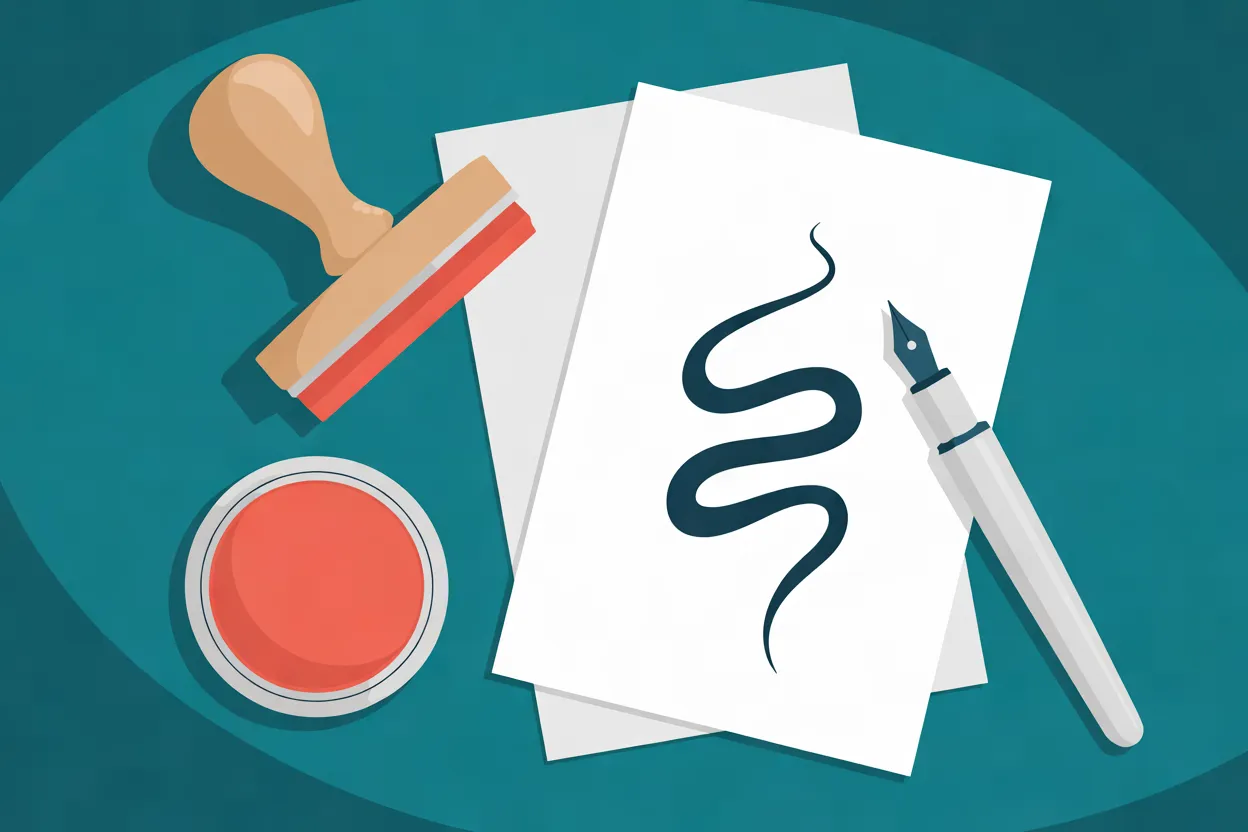
- A signature stamp. Rubber, made from a sample of the real signature.
- A signing machine. The autopen, which drives a real pen along a stored copy of a signature, is the best-known one.
- A printed signature on form letters, payroll checks or certificates printed in bulk.
- An image of a signature placed on a PDF with software.
What turns any of these into a signature, rather than a picture of one, is intent. The Uniform Commercial Code, the model law states adopted for checks and promissory notes, says a signature “may be made (i) manually or by means of a device or machine”, and may be any “word, mark, or symbol executed or adopted by a person with present intention to authenticate a writing” (UCC §3-401(b)).
Where the Law Accepts One
Some laws name facsimile signatures outright. Delaware’s corporation law, which governs every company incorporated there, covers stock certificates in one line: “Any or all the signatures on the certificate may be a facsimile” (8 Del. C. §158).
The IRS accepts them on a short list of business returns. Under Revenue Procedure 2005-39, corporate officers and authorized agents can sign Form 941 and the rest of the 94X employment tax series, plus Forms 1042, 8027 and CT-1, by “rubber stamp, mechanical device, or computer software program”. There’s a condition. The signer keeps a letter, signed under penalties of perjury, saying the facsimile is their adopted signature and listing the returns it went on. The letter stays on file for at least four years and goes to the IRS only if the IRS asks for it.
And at the top of government: in July 2005 the Justice Department’s Office of Legal Counsel concluded that a president may sign a bill by directing a subordinate to affix his signature, for example with an autopen (OLC opinion).
Those are specific permissions, not a general one. The same IRS that takes a stamped Form 941 wants a handwritten, wet-ink signature on a faxed or mailed Form 2848, the power of attorney form.
A stamp or signing machine is also easy to misuse, so keep it locked up. Under UCC §3-406(a), a person whose “failure to exercise ordinary care substantially contributes” to a forged signature on an instrument, such as a check, can’t assert the forgery against someone who pays or takes it in good faith.
A Signature Sent by Fax
The other meaning is the one fax users run into. You sign a page in ink and fax it, and the other side receives a copy of your signature rather than the ink.
Federal law doesn’t let a signature be refused just because it’s an electronic signature rather than ink. The E-SIGN Act says a signature or contract “may not be denied legal effect, validity, or enforceability solely because it is in electronic form” (15 U.S.C. §7001), and it defines electronic as technology with “electrical, digital, magnetic, wireless, optical, electromagnetic, or similar capabilities” (§7006).
Many contracts settle the question with a facsimile signature clause. A 2007 agreement filed with the SEC puts it in one sentence: “Any signature delivered by a party by facsimile transmission shall be deemed to be an original signature hereto” (Assumption, Adoption and Consent Agreement).
Handwritten, Facsimile, Faxed and Electronic Signatures
What each kind is, and the law on this page that speaks to it. Checked 7 November 2026.
| Signature | What it is | Where the law speaks to it |
|---|---|---|
| Handwritten (wet ink) | Signed in ink by the person, on the page itself | Asked for by name on some forms, such as a faxed or mailed IRS Form 2848 |
| Facsimile | A reproduction put on the page by a stamp, machine, printer or software | UCC §3-401(b) allows a signature made “by means of a device or machine”; Delaware §158 and IRS Revenue Procedure 2005-39 accept one by name |
| Faxed | A handwritten signature that arrives as a copy through a fax | A facsimile signature clause in a contract can make it count as an original |
| Electronic | “An electronic sound, symbol, or process” attached to a record and adopted “with the intent to sign” it | The E-SIGN Act, 15 U.S.C. §7001 and §7006 |
Where a Copy Isn’t Enough
E-SIGN carves out a list of documents and leaves them to the paper rules of each state (15 U.S.C. §7003):
- wills, codicils and testamentary trusts
- adoption, divorce and other family-law matters
- court orders, notices and official court documents
- notices that water, heat or power will be shut off
- notices of default, foreclosure, repossession or eviction on a primary residence
- notices canceling health insurance or life insurance benefits
- product recall notices, and documents that travel with hazardous materials
Being on that list doesn’t make a faxed or stamped signature acceptable for those documents. It means E-SIGN doesn’t help, and the state’s own rules decide. A will is the plainest case. In Idaho, which uses the Uniform Probate Code, a will must be in writing, signed by the person making it, and signed by at least two witnesses (Idaho Code §15-2-502). A faxed signature page isn’t the signed, witnessed will.
None of this is legal advice. For a will, a court filing or a form with a deadline, follow the receiving office’s own instructions, and ask a lawyer if they’re unclear.
Facsimile Autographs
Collectors use the phrase for a printed autograph. PSA, the card grading company, defines a facsimile autograph as “a reproduction of an autograph” and notes that many sports cards are made with one (PSA glossary). It’s part of the printed design. The player didn’t sign that card.
Making One of Your Own
On paper, it’s a signature stamp made from a sample of your signature. On a PDF, it’s an image of your signature: draw or type it in our free sign a PDF tool, place it on the line, and download the file. Nothing is uploaded, and there’s no account to make.
If the signed document then has to go by fax, Municorn Fax sends it from your iPhone or Android to US fax numbers and 90+ countries, and you can try it with one single-page test fax at no charge.
Frequently Asked Questions
Is a facsimile signature a real signature?
Is a faxed signature the same as a facsimile signature?
Can I use a facsimile signature on a contract?
How do I create a facsimile signature?
Sources
- UCC §3-401, Signature, Cornell Law School Legal Information Institute. Checked 7 November 2026.
- UCC §3-406, Negligence contributing to forged signature or alteration of instrument, Cornell LII. Checked 7 November 2026.
- Delaware Code, Title 8, §158, stock certificates. Checked 7 November 2026.
- IRS, Revenue Procedure 2005-39, facsimile signatures on employment tax returns. Checked 7 November 2026.
- Office of Legal Counsel, Whether the President May Sign a Bill by Directing That His Signature Be Affixed to It, 7 July 2005.
- 15 U.S.C. §7001, §7003 and §7006 (E-SIGN Act), Cornell LII. Checked 7 November 2026.
- Assumption, Adoption and Consent Agreement, 1 March 2007, filed with the SEC by Conversion Services International.
- Idaho Code §15-2-502, execution of wills. Checked 7 November 2026.
- PSA glossary, F, facsimile autograph. Checked 7 November 2026.